
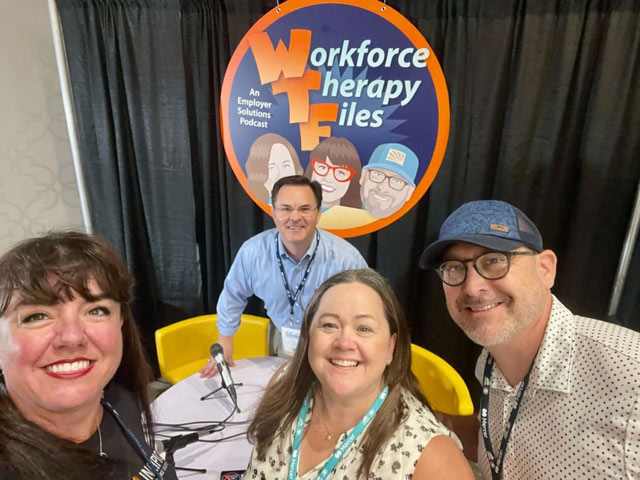
File 38: In this episode of Workforce Therapy Files, the hosts turn the tables and interview podcast producer Jim Ray about the growing role of podcasting in business, branding, and thought leadership. Jim explains why authenticity is one of the most important elements of successful business content. The conversation explores why podcasting creates from deeper, more engaging conversations that build long-term brand equity, as compared to traditional blogging and social media. The team validates the coaching and strategic guidance Jim provides clients beyond simply recording audio. This approach helps professionals communicate more effectively and confidently. The group unpacks how podcasting has strengthened their own communication skills, leadership presence, and team collaboration. Listen as the group shares humorous behind-the-scenes stories while also highlighting the discipline and consistency required to build a successful podcast. Today’s conversation reinforces podcasting as a powerful platform for education, relationship-building, and business growth.
Key Themes:
- Turning the Tables: Interviewing Podcast Producer Jim Ray
- The Hidden Work Behind Great Podcast Production
- What Separates an Average Podcast from a Great One
- Why Authenticity Matters More Than “Going Viral”
- From Blogging to Podcasting: The Evolution of Content Marketing
- How Podcasting Builds Confidence, Communication, and Brand Authority
- The Future of Podcasting and Why Long-Form Content Still Wins
Episode Transcript
Jamie Swaim:
On this file for workforce therapy files. We are incredibly honored to welcome an amazing guest, and I know I say that often, but today our guest is the person who makes the workforce therapy files possible.
Molley Ricketts:
Yay.
Jamie Swaim:
You may have heard him referred to as Jim Jimmy Jumbo.
Jason Heflin:
I called him Jimothy.
Jamie Swaim:
Jimothy is one of my personal favorites. Absolutely. The Jumbotron.
Molley Ricketts:
Did that just happen?
Jamie Swaim:
It just did. Alright.
Jason Heflin:
Wow.
Jamie Swaim:
Yes. Our producer, Jim Ray, welcome to the show, Jim.
Jim Ray:
Hey, thanks for having me on.
Jamie Swaim:
Absolutely.
Jim Ray:
Good to see everybody.
Jamie Swaim:
So I like to start with the most random of questions. So I’m going to ask you to suspend belief for a second and act like you are a burglar who just does pranks. Okay And you sneak into people’s homes just to mildly inconvenience them. Okay. So I’m going to give you some examples like mismatching all of their socks, mild inconveniences. What would be the signature prank for Jim Ray?
Jim Ray:
Throw pillows in the refrigerator because they have to wonder, how did I do that? Why did I do that?
Jamie Swaim:
He did that that so fast! He was like, I thought about, I’ve been waiting for the day that someone would ask me.
Jim Ray:
This was yesterday. What are you talking about?
Jamie Swaim:
Yes. I love this. I kind of want to round robin this for a second, Jim, because there’s a lot of questions we want to ask you, but I’m also curious about the answers of other folks that are on this amazing file. Heflin, what’s your prank?
Jason Heflin:
Oh my gosh. I would probably put different drinks in different bottles so they kind of see what…
Jamie Swaim:
Yes.
Jason Heflin:
Milk is in the orange juice and, you know.
Jamie Swaim:
Yeah, I like it. Molley?
Molley Ricketts:
I would probably do random things like put an egg in the mayonnaise or put the ketchup in the mustard. Kind of like your drink thing. Just everyday things. And you’re going to do it and be like, what the, why is there an egg in the mayonnaise?
Jason Heflin:
Yeah. What I really like to do is I usually go over to Jamie’s house and a hide her keys somewhere.
Jamie Swaim:
That’s you that’s doing that? All this time, I thought I was disorganized, you know what I mean?
Jason Heflin:
No. I sneak in on the weekends and before Monday.
Jamie Swaim:
Yeah.
Molley Ricketts:
So what about you?
Jamie Swaim:
I think I’d break in and leave stuff I no longer need from my house and people would be like, where did this come from? That is what I would like to do to people.
Molley Ricketts:
It’d be a great way to get rid of stuff.
Jamie Swaim:
Yeah. Because I know I need to declutter. And this would be like two birds, one stone. Yeah.
Jason Heflin:
I’ve got a cat. I’ll drop off.
Jamie Swaim:
You’d be like, this dog really gets on my nerves.
Jason Heflin:
Yeah, yeah.
Jamie Swaim:
Yes.
Jason Heflin:
We’ve got two cats. One of them I like a little.
Jamie Swaim:
I do have a second alternative and we can put this up to a vote and that would be just in honor of my husband is to go in and just turn all the lights on or put the thermostat to the actual comfortable that everybody’s got their degrees. They put it on in the winter.
Jim Ray:
68 degrees.
Jamie Swaim:
68 in the winter? So then I would go in the winter.
Jim Ray:
Well, 67 winter. It’s an ambient temperature.
Jamie Swaim:
Oh. I would go in and put Jim’s on 70 and just see what happens. You know what I mean? Because the kind of stuff that just…
Jim Ray:
Next thing you’re going to be adjusting my mics and everything else. I get you. Be that person.
Jason Heflin:
We have one of those thermostats you can control from your phone.
Jim Ray:
Oh, wow.
Jason Heflin:
And it is constantly changing. It’s probably going to go out within the first year because I’ll be like, why is it this temperature? And my wife will be like, why is it this temperature? I’m like, what? I don’t know. I didn’t touch it.
Jamie Swaim:
That’s when you change it from your phone phone and you’re like, it wasn’t on there. Yeah. Okay. Well, thank you. Good to know what kind of prankster you’d be.
Jim Ray:
Well, that and leaving random Post-It notes. “Hey, thanks again. Really appreciate it.”
Jamie Swaim:
Who wrote this?
Jim Ray:
Who wrote that? What is this?
Jamie Swaim:
I’m not losing my mind.
Molley Ricketts:
Nice flush.
Jamie Swaim:
Yeah, nice flush. Wash your hands.
Jason Heflin:
Yeah.
Jamie Swaim:
Good reminders.
Molley Ricketts:
That’s great. So today we’re interviewing Jim Ray, our producer, and can’t wait to learn more about what he does behind the scenes. We get to come into the room and he’s got us all set up and ready to go and we crack jokes and he records and then the magic happens.
Jim Ray:
That’s called massive editing.
Molley Ricketts:
Massive editing. So most people hear the final product, right? They hear us and they see us online producing everything, but we never see what it takes to create it. So today we’re flipping the mic. So what does a podcast producer actually do, Jim?
Jamie Swaim:
Yeah. What do you do?
Jason Heflin:
What do I do? I’ve been wondering.
Jim Ray:
Let me justify myself. No, I think a lot of it really, you guys actually came up with a concept. I mean, you all called me. We literally recorded episode number one in Molley’s office just on a, Hey, come out, come over and let’s just see if we can figure this out. We went from title, to concept, to what are we going to talk about, to episode one being recorded in about two hours. That’s probably the fastest implementation plan ever.
Molley Ricketts:
So you’re saying we’re easy to work with?
Jim Ray:
Well, yeah. It helps when you guys really know why you want to do this.
Jamie Swaim:
Yeah, I heard “decisive.”
Molley Ricketts:
That’s what I heard.
Jamie Swaim:
Action-oriented. Organized.
Jim Ray:
Results oriented. Yeah, that’s what I heard. No, but you guys all get along and that helps tremendously. You guys feed off of each other so well, and I think that comes through in the content, right? So that makes the editing a lot easier. There’s not a lot of times where you guys get stuck when you’re doing multiple people on the mic at the same time, somebody else can step right in. So there’s not any dead air in there. It’s just a great conversation. You guys each have your respective competencies. So from that standpoint, you’re constantly, okay, here’s the next level, the next level, whether it’s going deeper or just going further in the conversation. That makes it easy because I don’t have to pull you along and try to help you guys come up with the messaging. You have it and it’s just a matter of delivery.
My job is just to make sure that one, we sound as good as we can on the mics, which is fantastic for you guys, in terms of what we’re able to do with the mic quality. Beyond that, you guys just keep bringing guests. You guys keep bringing ideas, your ability to kind of walk into the room and sometimes the episodes are really well planned out. Other times it’s, Hey, okay, let’s come up with something on the fly. And actually some of those are the better episodes just because it’s organic and it’s right there and you guys just play off each other.
So the big part of my stuff is making sure that the sound is good, making sure the distribution is ready to go, and then kicking it over to Jason’s team for uploading to the website and social media. But you guys execute and that makes it fun.
Molley Ricketts:
So what do you think separates a good podcast from a great one?
Jim Ray:
Interesting. I think knowing the purpose of the podcast. So many times I’ll have somebody who’s interested in doing a podcast and they walk in and they think they’re going to be the next Joe Rogan, and it’s just not going to happen.
Molley Ricketts:
What? It’s not going to happen? Maybe in the next year.
Jim Ray:
You guys are on your way. But you haven’t arrived, but it’s keeping you enthusiastic along the way. No, you guys understand the “why” each of you work in the HR space. Each of you work in staffing and workforce development, so that helps. Even from the marketing standpoint, a lot of your clients, Jason, are large hirers who need help. And so you’re in this game as well. And so again, you guys all have a common mission and that works well.
What’s interesting about you guys is you’re actually three unique businesses and you guys are coming together as a collaborative podcast, which I think is a great way to do it. But you’re coming at it with different perspectives. You’re not getting the same sheet of music, you’re not getting the same lines that are inside. So the fact is you guys know what you’re looking at and what you’re trying to accomplish, and I think that makes you much better than average. Great? We’re still going. I think eventually if we can get into video, I think that takes it to another level. But right now, I mean you guys are overperforming, you’re always enthusiastic and you’ve got really good content.
Jason Heflin:
So this is the Jim Ray way, by the way. We’re asking him questions about himself and he just turns and starts talking about us because he’s a complimenter. He brings other people up. That’s what he does.
Molley Ricketts:
And he does.
Jason Heflin:
And I think that’s what makes, I mean, I’m going to go ahead and put it out there, but I think that’s what makes you such a great producer is you’re constantly, you’re part of the process too. We’re in here doing this, but you’re that other voice of reason and you check us. Well, what if you tried it this way? What if you tried it that way? What if you started this way? So you are a bit of a director as well. It’s not like we’re in here just talking. I mean, before we get started, we map everything out on the board. You help us do that. You kind of check some of the things we say. You think about it from the audience perspective versus just us. Here’s what we want to say. And you talk about how it’s going to be received. So I think there’s a lot of directing too, not just producing in it. What do you think about that?
Jim Ray:
No, that’s a real good point. And I think that’s more and more you’re seeing little podcast studios pop up and people going, Hey, come on in. We’ll do a podcast. And really what it seems to be is more of I’ve got a mic and the software, you bring your voice and talk. Here’s your recording. And that’s only going to go so far. That’s why a lot of people burn out. The majority of podcasts never reach 10 episodes. They literally never reach 10 episodes. I just think it’s different. I think it’s more involved than what people think.
A big, coming back to your point, Jason, a big part of this is the coaching aspect is being able to watch outside of the bubble saying, okay, here’s what you guys are doing. Does that make sense? Hey, what if you tilted it this way? Some of what we do process-wise was because early on, you guys let me become a little bit more involved in the origination and how are we going to set up this process? And now you guys have got it. You run with it. This is what you do when you come in. So yeah, I think the coaching aspect is my differentiator rather than, Hey, I’ve got a place you can come in and talk on the mic. That gets boring real quickly.
Jason Heflin:
You work with a lot of podcasters or professionals that are starting podcasts. Do they all come in with a fully formed idea?
Jim Ray:
Not really. Some of them know they want to do it. Some of them are unaware that podcasting might be a marketing option for them. They’re thinking blogs. They’re thinking social media. They’re thinking, I got to buy a Google pay-per-click ad or something like that. They haven’t really thought about podcasting because they’re thinking more of the Joe Rogan’s, the Martha Stewarts, the true crime novels. They haven’t really seen it as business content. But very quickly, I can kind of take that kernel and turn it on its side and go, no, this is why this would be more important to you and the organization at large. And then when I can get a group of professionals who are talking, that becomes a lot more interesting because it’s not just one person droning on and on and on like I’m doing in this very answer, but it’s more that feedback and that playing off of each other that it just adds to the conversation.
Jason Heflin:
And I think a lot of people come in thinking, I am going to be the next big podcast star. I think one misconception that I see is that those people that are really successful at podcasting typically have stardom to begin with. The Martha Stewarts, the Joe Rogans.
Jamie Swaim:
Don’t forget Amy Pohler.
Jason Heflin:
Yeah, Amy Pohler. Jason Bateman, all the big podcasts out there right now.
Jim Ray:
They’re playing off of a foundation.
Jamie Swaim:
Yeah, they’ve already got that. I think for us, it took a while to get some steam in the engine and we’re at several thousand listeners downloads whatever now. And you’ve got several podcasts that are in that bucket, right? I mean, among all your podcasts, you probably have tens and tens of thousands of listeners. So I mean, that’s a testament to creating good content. And I think if anyone out there is thinking about creating a podcast, Jim’s the perfect person to talk to because he’s going to coach you through it. He’s going to question some of the things that you’re doing so that you can make it better. Any idea that comes out of your head’s not going to be fully-formed, so it needs a little bit of massaging. And Jim’s a great masseuse. He’s a great podcast masseuse.
Jim Ray:
There you go.
Molley Ricketts:
Podcast masseuse.
Jim Ray:
Podcast masseuse. I’ll put that my business card.
Jamie Swaim:
I don’t why it wasn’t already.
Jim Ray:
Well, Molley’s got head honcho on hers, so maybe podcast masseuse. There you go. Jason, Jason actually runs, owns and runs a marketing agency down in Bowling Green. And so you kind see some of this, and I really appreciate the fact that you’re pointing some of that out because I think, again, a lot of people just don’t know what to do with this medium. They like the idea, but what am I going to talk about? Who’s going to listen? It’s about consistency. It’s really about consistency. You guys have gone several seasons now. There are things that you guys are doing. We’ve been to the Kentucky SHRM conference a couple of times now. There’s just a rhythm and it becomes, I think, a little bit easier, but it also builds up that audience expectation, which is, again, that’s fun when you’re getting feedback, when you’re getting other guests coming on going, oh, I really like this. It’s just some validation for the people who are actually trying to do it. So it’s not always, Hey, I got this new client. Some of it’s just the brand positioning and each of you have your own respective brands, but I think this combined conversation actually helps with that.
Jamie Swaim:
I think it feels way less intimidating now, too. I don’t know about you guys, but whenever we first got started in my head, I was picturing the tens of thousands of people that were going to be listening to us (side eye), but I didn’t know how comfortable I’d feel, and it felt very much like a public speaking experience versus now, it feels very much like we’re hanging out in an office together and talking about something that we all feel really excited to talk about.
I’m curious though, Jim, because I’m a people person, so I want to know your hero origin story. Is this the career you thought you would have whenever you graduated from college, or how did you get here?
Jim Ray:
Absolutely not. This is not at all what I thought. I grew up with my grandmother. My grandmother was actually blind, so the way I communicated with my grandmother, even as a small child, had to be much more descriptive. So verbally, I was always pretty good. I ended up in sales. I did sales and sales management for 20, 30 years now, and then eventually in my own company when I was doing things such as web development and coaching and things like that, that was fine, but that became commoditized.
When Google finally blessed podcasting is a legit form of content for search and everything else that made perfect sense. Within three months, I had a product and a service on the street and did very well that first year. And you learn as you iterate, you just get better and better and better, and you learn ways to improve the quality. Ways to improve the efficiency, and ways to talk a little bit differently with different groups of clients.
This is what I do. This is the majority of my revenue stream now as a business. It’s just fun. I mean, it is really fun. You guys had asked when you first came in this morning about something that I’m excited about. We just launched a podcast for a different organization, but it’s a nonprofit that I got to have a hand in and we hit the deadline, we got everything going. We went from concept to delivery, and it’s been a great journey.
So that kind of stuff, I like when the light bulbs go off and you’re helping somebody. I don’t have to be in the spotlight. That’s why I don’t mind being the producer. I don’t need to be in the spotlight, but I get a tremendous amount of joy on watching you guys have a great time and knowing that we’re putting something else out there in the ethos that’s actually going to help promote your respective brands. I love that stuff.
Jamie Swaim:
Yeah. I would imagine also that being in the seat that you get to sit in, that you’ve learned all kinds of amazing things that you had no idea you even wanted to learn about. So what was the topic that you were like, I get to know that information today, or I learned something new and you were super excited to learn it?
Jim Ray:
Well, I think as we started looking more at video podcasting, I was a purist, right? The reason I like podcasts is because I think I can put my earbuds in and I can multi-task. I can do other things, but I’ll still listen to that content.
As someone who was a content creator, I used to write a tremendous amount of blogs for law firms all over the state of Kentucky. I used to do a lot of video work, and I really liked those media, those formats. But when you’re doing this and you know it’s a podcast, I always thought, well, the reason it works is because I’m not competing for your attention. I’m going to ride along with you. I’m going to go with you while you’re shopping, exercising, whatever, driving the kids to school, whatever you’re doing. I held back on video for a long time, but now it’s becoming more and more prevalent, and now I’m able to step in. I’m going, you know what? I’m actually beginning to pull that off, that it’s actually looking better and better. I’ve got a long way to go. I am not a videographer, I’m not a video producer, but I understand the reason for the media format and how to put it to work, and if I can continue to do that on a bigger scale, so much the better. Yeah.
Jason Heflin:
This is a business question, how much bandwidth do you have for those listening? If they’re like, I want to start a podcast, but this guy sounds like he’s busy or expensive, or maybe he’s a little bit more advanced than what I’m capable of, maybe I’m not ready. Dor those listening that are thinking those thoughts. What would you say?
Jim Ray:
Well, let me start with this because I think this is one of the more important impediments there. If you have headphones or earbuds and an iPhone, you could do conceivably a podcast, whether it’s effective or not, or the quality that represents your brand best, that’s up to you. That’s personal interpretation.
As far as what I do is I give you guys back something you don’t have enough of, and that’s time. I tell my clients, look, I need you for about an hour and a half, once a month. Come on in. We’ll do a couple of episodes back to back. I’ll fully produce them. I’ll edit them and I’ll dose them out. Usually every other week, a new episode goes live. So my bandwidth demands are not that much in terms of, oh my gosh, I’m just totally swamped right now, because I can choose when I decide to edit that episode.
If I know you’ve come in and you’ve put several episodes together, I’ve already got them recorded. I don’t need to chase you down. I can wake up early on a Saturday morning and knock out an episode. I can stay up late on a Wednesday night and just take care of some other finder points on the editing process. It’s not all that, I won’t say it’s not taxing, but I’ve got a lot more bandwidth because again, as a solo, I choose when I want to do this. If I want to stay at work, because I love what I’m doing, for a couple of extra hours, I get to do that.
All I have to worry about really is hitting the deadline. When does this have to go live? And for most of my clients, we have a scheduled go-live date. It’s usually in the morning and it’s a certain day of the week. So once we have that scheduled out, I’ve got time to get there, and it’s just a matter of how I want to actually get there. I get to do all the sausage-making that you guys don’t have to see. That was the theme of this episode, I guess. But yeah, the bandwidth is there. Will it get tighter and tighter? Yeah, it’s supposed to, but that doesn’t mean I can’t bring on somebody else to help out with some of it. And there are ways, there are just things I’m learning to do now that I didn’t know three and four or five years ago that make me a little bit more efficient today.
Jason Heflin:
Yeah. What do you think the future of podcasting is?
Jim Ray:
I think this becomes the predominant medium, and I’m not just saying that because, hey, Jim has a hammer, so every problem starts to look like a nail
Jamie Swaim:
Well, when Netflix started to add podcast as something that’s on their streaming platform, I felt really surprised by that because it’s not normally considered a visual medium, but it’s become a lot more than that.
Jim Ray:
This is what blogging was 10, 15 years ago, and if you were in content production or content development or any kind of marketing, you understood the impact that blogs were having. This is just a different format of blog.
I think people are getting so tired of the short form, the TikTok oriented format where, okay, it’s entertainment value, but you can’t really get substance out there. Whereas in a podcast, you can do a deep dive. You can really explore a topic, and this may be an episode that I later on forward to a prospective client to give them some more insights into how I think about a certain topic, or maybe we had a great conversation, I can record it one time and distribute it to 300 different clients if I were a larger organization, had the need to do so.
It’s evergreen. It lives forever. Even if you stop producing new episodes, it’s still out there as long as you’re paying the hosting fee, it’s still out there. So again, you’ve got residual equity. I’ve always told people, look, if you’re going to do any kind of marketing, make sure you’re building equity so that if you stop, it’s still producing for you. It’s not a pay-per-click ad or a television commercial, a radio commercial, a billboard. Once I stop, it goes away and nobody ever knew it was there to begin with. Something like a podcast, which is a deep dive discussion, actually has residual value day after day, week after week, quarter after quarter, year after year.
Molley Ricketts:
Yeah. So Jim, when you hear ideas that people may bring you, what do you think that business leaders should really understand about podcasting as a platform? So you said this is the new blog. What are some things to consider when you’re talking to a business leader about considering a podcast?
Jim Ray:
I think you’ve got to be willing to be authentic. I mean, if you come in with a mask, over time, people are going to see that mask slip. You’re going to make a comment that doesn’t align with that image you were trying to convey. If you’re just yourself, most of the time, that’s what I’m looking for. I’m looking for authenticity because I get sales pitches every day. We all do. If you own or run a business, you’re inundated with sales pitches, and some of them are pretty daggone good. But I don’t know, okay, once I buy it, is it going to deliver? Is it going to meet the expectations?
The same goes for you if you’re doing a podcast, depending on what the idea here is. I want to have thought leaders who want to come in and share their knowledge, and that’s what the three of you guys do. You’re not actively hard selling. You’re providing terrific information in an entertaining format that makes me want to align more closely with your brand. You heighten my curiosity.
Jamie Swaim:
You actually remind us to, don’t forget, say your company’s name from time to time.
Jim Ray:
Yeah. We put that in all the show notes, links out to everything. I mean, yeah, sometimes you get wrapped up into it. Again, because I’m outside of the bubble, I get to look at the other little aspects that are actually critically important. Oh, by the way, here’s how you get ahold of me. Things like that. But once you kind of get that down again, for somebody that’s thinking about doing this, especially a C-level executive, do I have the time? You don’t have the time not to do this, because if I’m going to hire the company, I want to know what the leadership thinks. I want to know how you think. I want to know why I should be considering that. And wow, okay. So now you’re conveying it at a time where I can consume it when it’s most convenient to me. Now that shows that you’re putting me first as a client. Now I’m more interested because you’re more aligned with my value system, ideally. I mean, we’re not selling retail products. These are corporate strategies. These are important topics. It’s a different way to go to market
Jamie Swaim:
For leaders that are listening right now. One of the things I’d like to highlight that I don’t know that I’ve ever told you this, Jim, but since starting this podcast, one of the things I’ve gotten more comfortable with is those moments where you’re in ad hoc conversation with somebody that doesn’t know you very well, and finding new ways to communicate that resemble more clearly my tone and voice. It’s one of the reasons, for example, why blogs are starting to feel stale to me because of how many creators are using AI as their content source. Right? But whenever I feel like whenever we get on a microphone and we’re able to have a conversation and be ourselves, that has now translated into my work life.
So I will make small videos for my team, giving them updates, answering questions that have been posed, rather than just responding in the written way or doing something that’s more stale. It’s in the moment, and my team loves it. Absolutely loves it. So to me, this is skill-building. And with your tutelage, That’s a thing, right? Yeah. Did I make that word up? That’s a great word.
Molley Ricketts:
This just came from nowhere, but I’m impressed.
Jamie Swaim:
We’re growing skills because of the opportunity to be able to do this with you.
Jason Heflin:
And vocabulary.
Jamie Swaim:
Vocabulary and vocabulary. Yes.
Jim Ray:
No, I think when you’re on the mic, even though we’re not live at any given time, we still have room to edit. It brings out your truest sense of self. I mean, if you’ve ever written a blog post, how many times have you gone back and self-edited? Okay, wait a minute. That doesn’t sound right. No. What are people going to think? You put all these friction points in the process, which is why they take longer, and they usually don’t get done consistently. Whereas when you’re talking, you’re just having a conversation about something you already know with people whom you like. And I think that’s what your truest sense of self actually comes out, and that comes back to the authenticity, which is really what the market wants most. And so, yeah, no, I appreciate you saying that. It’s a confidence-builder for all the other things that you’re doing.
Jamie Swaim:
It’s a comfort builder as well, just to be who you are and to lean into what are the things that you know about a particular topic, because that shows up in a lot of different ways, whether or not you have it or you don’t.
Jim Ray:
Well, what’s funny is if you go back and you go back to episode one, file number one for Workforce Therapy Files…
Jamie Swaim:
I don’t know if I ever want to do that.
Jim Ray:
Well, no. Listen to the first two episodes and ask yourself, wow, how much different do they sound now? The flow is there. I mean, you guys are on lock and it, it’s not really work. It’s not, oh my gosh. We have had times where we come in and said, okay, what are we going to talk about today? And we put the outline on the board and went, and it actually turned out great, because again, you guys have the process down.
This is about reps and muscle memory. Once you get that down, you’re already subject matter experts. So you just allow that to come out. Again, let’s get the friction out of the way and let the knowledge flow, and that’s what you guys do.
Jason Heflin:
And I’m going to connect a few dots really quick because it was kind of under an undertone, but we talked about blogs and how I think a lot of people are still like, well, I’m a blogger. I’m blogging. Blogging is how I get my content out. But then you mentioned show notes earlier, and it made me think, one thing that I think folks don’t think about who are currently blogging and using that as their content medium, is that Jim produces a transcript of every episode. It’s chock-full of keywords and things that we talked about and the topics, and that all goes into blog posts. So if you’re concerned about, let’s say, your website’s SEO, and oh, but my blogs really contribute to my SEO because they’re continually feeding the algorithm. Well, this is just more content.
So you can continue to blog and supplement with podcasting at first, and then at some point, some people just say, I’m just going to do more podcasting and just upload that content. So it’s a new way of thinking, and sometimes it’s hard, but it still ties back to all the old platforms we use.
Jim Ray:
And again, you run a marketing agency, so you guys blog. You guys produce a tremendous amount of content for your own clients, I would imagine. So I look at it this way. I used to get paid a decent amount of money to actually sit down and write a six paragraph blog post for, say a law firm, on a consistent basis. And I know how much time it took me to come up with a title, come up with some subtitles, maybe a nice image, some bullet points, and some pithy content ultimately to get down to the call to action.
Molley Ricketts:
So we’re just Webster here today.
Jim Ray:
Pithy you like that? You like, okay, great. So I knew what it would take to do that, and they’d get six, seven paragraphs maybe. If we have a 15-minute conversation, how many paragraphs did we just create? It’s infinitely more. It’s infinite. So much less time to create and much more in terms of context, content and just overall quality of experience for the listener.
Now you start looking at derivative products. Now, okay, so I’ve got that. I’ve got the blog post and I’ve got this say, audio podcast. Now I can splice that up into outtakes snippets, if you will. That can go on the social media. I can take the transcript and now I can convert that over into a separate blog post from the transcript or the audio. I’ve got that. And then I can break that down even further for additional social media. And oh, by the way, the whole time linking it back and forth to previous and related pages and websites. It’s just so much more effective.
Jason Heflin:
The mileage you get out of it is incredible.
Jim Ray:
Exactly.
Jamie Swaim:
I also really appreciate that the show notes, and Jason mentioned this, but you’re very careful not just to provide a transcript, but you get a link to each of us in the bottom of the show notes.
Jim Ray:
To your guests as well
Jamie Swaim:
To our guests. We’ve used it as an opportunity to plug books that were mentioned from previous guests. And I don’t know that every podcast provides that level of content to serve as supporting information if somebody wanted to go and reference it quickly, instead of having to go back and try to be like, was that at minute 20 or 21? And I really appreciate the production of those show notes. It’s been very helpful for me in figuring out which episode I wanted to refer back to for different engagements.
Jim Ray:
Well, yeah, and there’s always going to be a key phrase in there that might relate to a previous episode or something like that. But again, that comes back to that coaching mentality, those competitive advantages that I think I bring as a podcast producer is I’m not just saying here, just talking to the mic and I’ll give you a recording. I’m going to do all these follow on assets that make it more powerful, that make it much more effective, and that serve additional purposes. All of this should be weaving together a constant theme based on what you do. You guys are in HR, okay, great. You’re in marketing, so it should be doing all of those different things together so that you’re just pounding your website and all these other social media platforms with great on-point, consistent, authoritative content. That’s why I think podcasting, when you ask, where’s it going? I think podcasts becomes the preferred medium.
Molley Ricketts:
Okay. I’ve got a very important question to ask Jim.
Jim Ray:
Five seven.
Molley Ricketts:
I thought it was 6 7. No, thank you, Jim.
Jamie Swaim:
Jim, starting a new trend.
Molley Ricketts:
HR nightmare. So Jim, what do you think is the best episode for Workforce Therapy Files? So far?
Jamie Swaim:
Putting you on the spot. Wow.
Molley Ricketts:
Your favorite the best?
Jason Heflin:
This one.
Jim Ray:
The ones that talk about me. Let’s see. You guys did a Halloween themed one, which was kind of interesting. That was creative. That was good.
Jamie Swaim:
Spooky recruiting stories.
Jim Ray:
Yeah. Early on, you guys were bringing in much more data. I think you were bringing in Bureau of Labor Statistics data, and that was informative.
Jamie Swaim:
That one was one of my favorites too, though. We went through the Workforce Report.
Molley Ricketts:
That was two episodes, wasn’t it? Yeah.
Jim Ray:
You guys have brought in other, just thought leaders. You brought in Dr. Deborah Clary, who really is doing her own thing after just a terrific executive career, and now she’s off into coaching and it launched a new book and things like that.
What I love is the miniseries. The miniseries that we do from SHRM where we’ll go do a popup podcast there for two days and we’ll come back and we’ll get 20-30 podcast episodes, mini-interviews, out of that. And it keeps producing for you all. But at the same time, just the tone of those many impromptu discussions are just fun. I mean, watching you guys just be in the moment and just having fun at a conference, a trade show, whatever.
Molley Ricketts:
I mean, we’re a pretty good time.
Jamie Swaim:
Yeah, that’s true.
Jim Ray:
You guys are a good time.
Jamie Swaim:
You should hear us when we don’t talk about work.
Jim Ray:
No. So to come back to say just one, no, there are different styles and formats that you guys have done that I think each have their own benefits and they’re going to resonate with different types of audience members, right? Not everybody wants the casual, they want the more authoritative data-specific. You guys deliver that as well.
Jamie Swaim:
I think I’m hearing Jim say it’s hard to choose which one says favorite.
Molley Ricketts:
That’s what I think too.
Jim Ray:
The answer is D, all of the above. Yeah, there we go.
Jason Heflin:
Which one of your kids do you love the most?
Molley Ricketts:
So do you think of a conversation and think, man, Workforce Therapy Files needs to talk about that?
Jim Ray:
Yeah. I think from time to time, I’ll send you guys an email with just a, Hey, here’s a video that I saw, or here’s an article, or, Hey, this is interesting. You guys could develop something off of that. And I think, again, having something that’s also looking to promote your authoritative information. Sometimes you just don’t think, we all kind of get in our own silos and we’re thinking, well, this is what I usually talk about. And then somebody throws something over the wall and you’re like, oh, that’s cool. Let me see where that goes. I try to do that as well.
I think that, again, it is part of the coaching. How can I make you guys more successful at what you’re doing? Sometimes it’s topic selection. Some topics just seem to resonate and everybody’s in it. Sometimes not as much, but it’s still good information, right? So if we can start to look at different sources of information for a potential topic, I like doing that. It just keeps it fresh, keeps it fun. Not that you guys have the problem with keeping it fun.
Jamie Swaim:
Jim. So the listeners are saying, I can do it. I can do a podcast. I know I can. Now I feel confident. What’s the first step? How do they get in touch with you? How do they get started?
Jim Ray:
I appreciate you saying that. I think the easiest thing is let’s have a conversation to make sure that your expectations are realistic from the outset. Not that they can’t evolve into something even bigger, but let’s have a conversation. There are a number of different ways to get to me. My website is JimRayConsultingServices.com. You can just call me here at the office, (502) 208-9639. Probably the easiest way to grab me, just say, Hey, send me a text to that number. Actually, Hey, I heard you on the podcast thinking about doing my own. Can we chat? Easy, easy, easy, easy peasy.
Jamie Swaim:
Jim, will you put that in the show notes?
Jim Ray:
Yeah, great idea. Okay, great idea. Yeah, I’ll put links to all that.
Jamie Swaim:
And if Jim doesn’t answer the phone, he’s probably recording an amazing podcast, so he will call you back ASAP.
Jim Ray:
Or a podcast that features me. But yeah, so it’ll all be good. No, but guys, I appreciate it. This is kind of fun to turn the tables a little bit and actually be on the mic with you. So I really appreciate the opportunity here.
Jamie Swaim:
I think you were just as good on this side of the mic.
Jim Ray:
What? I mean, I’ve done this a couple of times, just once or twice. But no, I appreciate you guys saying that. But thanks for the opportunity. And the fact is you guys are producing just different types of content at a higher-level one than when you originally started. It’s just come that much further, but it’s just fun watching you guys in your zone. Anytime I can watch a group of high-performers just actually get together and actually do what they do best, it’s just fun. I mean, it’s literally fun.
Jamie Swaim:
Well, thank you for agreeing to get on this side of the table and Jim Ray of Jim Ray Consulting Services. Close that file, close that file.
That’s where we’ll leave the conversation for today. Before we close the file, we invite you to reach out to us with questions, suggestions or other comments. We’d love to hear from you.
To Contact Podcast Producer Jim Ray:
Website: JimRayConsultingServices.com
Phone: (502) 208-9639
That’s where we’ll leave the conversation for today. Before we close the file, we invite you to reach out to us with questions, suggestions or other comments. We’d love to hear from you.
Did You Enjoy Today’s Conversation?
Visit WorkforceTherapyFiles.com to listen to additional WTF files or to let us know you’d like to be a guest on an upcoming file.
Need Help Supporting Your Company’s Recruiting and Staffing Goals?
We’re here to help. You can contact us via our individual websites, depending on your specific needs or questions:
- Jamie Swaim, SPHR – www.ParcelKnows.com
- Molley Ricketts – www.IncipioWorks.com
- Jason Heflin – www.CrowdSouth.com
We hope you found this file insightful and helpful. Thank you for listening!